Proof on every lot, not a promise on the label.
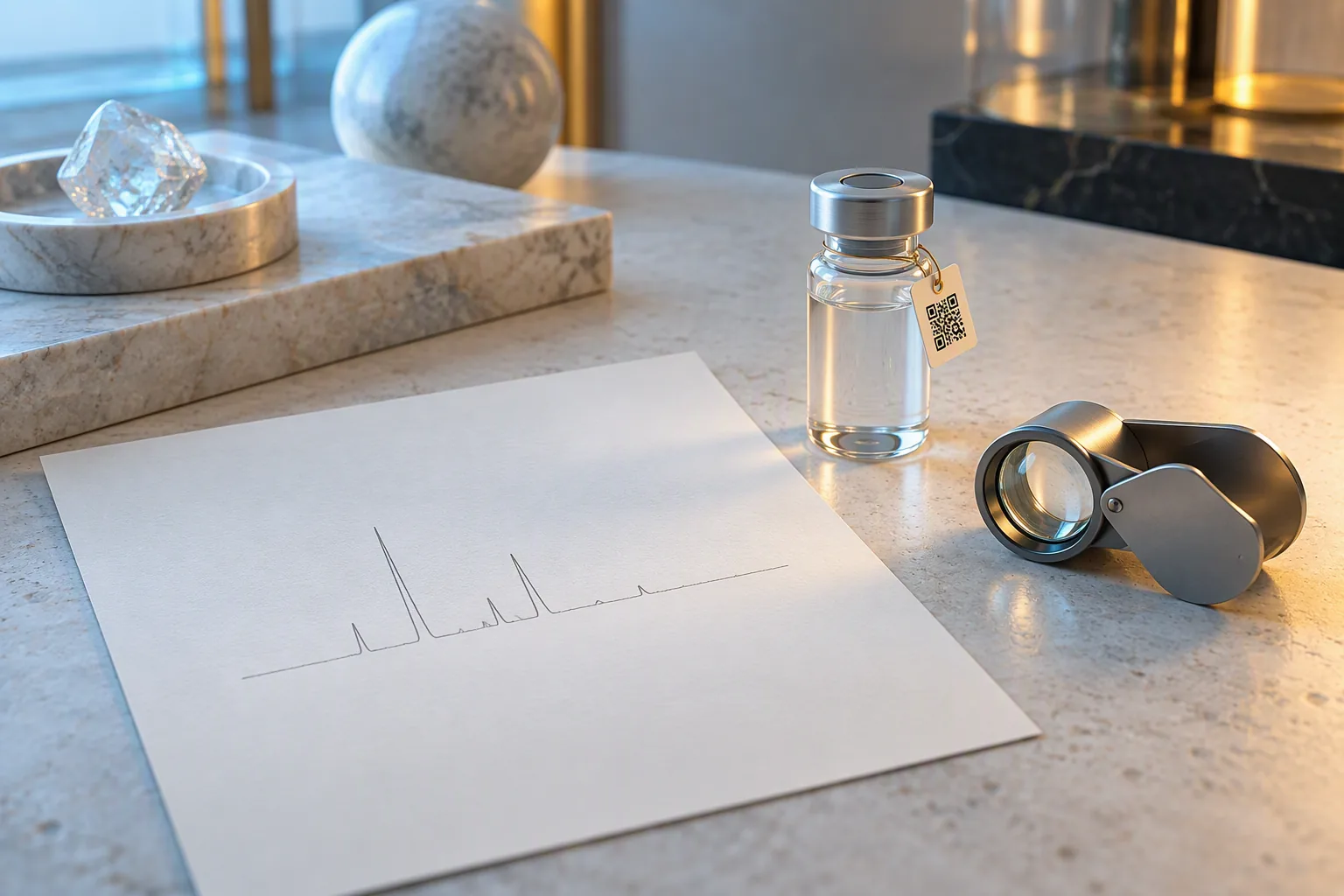
Each sterile lot is tested for purity, identity, endotoxins and sterility before release. The lot number printed on your vial opens its certificate.
Lot lookup
Find your certificate
Try:
Demo: certificates are generated for the mockup and are not real test results.
What we test
Five tests, one lot number.
| Test | Method | Release threshold | Why it matters |
|---|---|---|---|
| Purity | HPLC | ≥ 99.0 % | Confirms the vial contains the peptide, not truncated or oxidised fragments. |
| Identity | LC-MS | Mass within 1 Da of theoretical | Proves the molecule is the one on the label. |
| Endotoxin | LAL, USP <85> | < 1 EU/mg | Bacterial endotoxins cause fever and inflammation on injection. |
| Sterility | USP <71> | No growth, 14 days | Confirms aseptic compounding worked for that lot. |
| Potency | Assay vs. label claim | 90–110 % | Your dose in units equals the dose your doctor intended. |
Where it is made
An ISO 5 hood inside an ISO 7 cleanroom.
- Positive-pressure cleanroomISO 7 buffer room with an ISO 8 ante-room, HEPA-filtered air changed at least 30 times an hour.
- Laminar-flow hoodAll sterile work happens under an ISO 5 primary engineering control, to USP <797>.
- Trained, tested peopleGarbing, media-fill and glove-fingertip testing for every compounder; environmental monitoring on a schedule.
- Cold storage, logged2–8 °C fridges with calibrated continuous data loggers and daily min/max review.
- Release by a pharmacistNothing ships until the responsible pharmacist signs the lot's certificate.

Four things to check.
- The lot number matches the vial. A generic certificate with no lot is a red flag.
- Dates make sense. Test date after manufacture date, and a named laboratory with ISO/IEC 17025 accreditation.
- Actual data, not just a tick. A purity figure with its chromatogram, not "> 99.5 %" and nothing else.
- Endotoxin and sterility are present. Purity alone says nothing about whether a vial is safe to inject.